
The public sector’s Pay Transparency advantage
I was doing some research for an infographic (more on that in a future newsletter) and I came across some interesting data about gender pay gap differences between the private and the public sector. I thought it would be good to share, because we often look at the private sector for the latest developments. But on the topic of pay transparency, it seems the public sector has the advantage. Let me show you what I found at Eurostat, which is a treasure trove of workforce information!
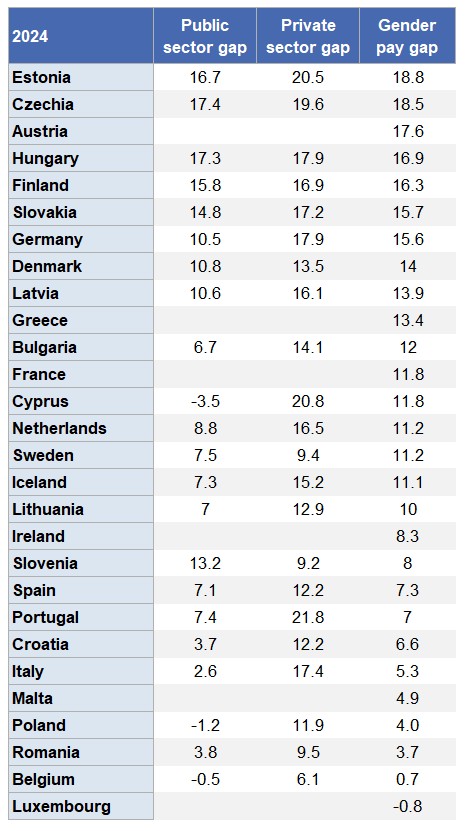
Source: Eurostat 2024. Note: Austria, France, Greece, Ireland, Luxembourg, and Malta do not report sector-level data separately. Negative values indicate women earn more than men on average. Gap = unadjusted gender pay gap.
I thought it was interesting that country after country tells the same story: the pay gap in the public sector is lower than the private sector. Germany’s public sector gap sits at 10.5%, while its private sector gap is 17.9%, which is nearly double. Portugal is more striking: 7.4% in the public sector, 21.8% in the private sector. Cyprus shows women earning 3.5% more than men in public roles, while the private sector gap there is a substantial 20.8%. Slovenia is the one exception in this dataset, with a public sector gap that exceeds its private sector figure as a reminder that no public system is automatically equitable.
What’s driving this difference? Is it simply that public sector jobs are more regulated?
While that would be the obvious answer, regulation alone doesn’t explain it. The deeper answer is about how pay gets set in the first place. Governments have operated collective bargaining agreements and standardized pay bands for decades. When a Grade 7 policy officer earns a defined salary range regardless of who they are (aka their personal characteristics), the scope for individual negotiation disappears. Pay is fixed and everyone in the same role at the same level earns roughly the same amount. That single feature eliminates one of the biggest historical drivers of gender pay disparity: the negotiation gap. Women, research consistently shows, start pay negotiations just as often as men, but their attempt is more often ignored or turned down. So when you remove individual negotiation from the equation, you remove a significant source of divergence at the point of hire.
The private sector operates very differently. Even if a company has a pay structure, base salaries are often negotiated individually, bonus structures are discretionary, and progression decisions rest more heavily with individual managers. Performance-related pay compounds small differences year over year. A 17% gap isn’t hard to explain when you trace those dynamics across a ten-year career.
In addition, occupational concentration plays an important role. The public sector employs large numbers of women in professional roles, from healthcare and education to social services, where pay has been partly protected through collective agreements. The private sector has higher concentrations of women in lower-paid service and administrative roles alongside a smaller group of highly paid men at senior levels. That distribution alone widens the unadjusted gap considerably.
Does a lower gender pay gap mean the public sector is ready for EU Pay Transparency reporting?
Not even close, and this is one of the most dangerous assumptions I see senior comp leaders in the public sector make. Just because you have the structures in place, does not mean you are compliant.
A lower unadjusted pay gap tells you that the overall average difference between men’s and women’s pay is smaller. It says nothing about whether that difference is explained or justified. It says nothing about equal pay between men and women in a job level (the number that shows up in the ‘category of worker’ report.) The Directive doesn’t ask you to report a single pay gap number and call it done. It requires that you demonstrate, job category by job category, that pay differences are based on objective, gender-neutral criteria. That’s a fundamentally different exercise that even public sector comp leaders must engage in.
And let’s take Germany’s public sector gap of 10.5% as example. It’s lower than the private sector’s 17.9%. But 10.5% is still 10.5%. Under the Directive, the threshold is 5%. And if a joint pay assessment reveals that this 10.5% gap can’t be fully explained by factors like seniority, experience, or performance criteria applied consistently, the employer is required to take corrective action within a defined time frame. The size of the gap doesn’t determine whether you have a problem. Your ability to explain in terms that are the same for everyone does.
Public sector employers also face a challenge that often gets overlooked: many don’t yet have the analytical infrastructure the Directive actually requires. The data exists in HR systems, payroll, time, collective agreement schedules, but these systems have often been used for a long time and might even be outdated. They are rarely integrated in a way that produces Directive-compliant reporting by job category and seniority level. And that means they have work to do because all employees have the right to request pay information under the Directive, private and public sector alike. Reports must be made available on request. And most public employers are not set up for that today.
What about the job evaluation frameworks themselves — don’t those help?
In theory, they should, but in practice, they often carry their own problems. Job evaluation frameworks, the methodologies that determine which roles sit at which grade and therefore which pay band, were often designed decades ago, in organizations where leadership was predominantly male. The competencies associated with male-dominated roles were treated as inherently more valuable: problem solving, technical expertise, physical demands. Competencies more commonly associated with female-dominated roles, such as soft skills, communication and caregiving, were systematically underweighted or left out of scoring criteria entirely.
Public sector employers have used these frameworks for a long time, which means the bias isn’t in individual discretionary decisions. It could be baked into the architecture. A nurse and an IT technician might sit in the same pay band. But often, the technician sits higher, not because a manager made a biased call but because the job evaluation criteria scored it that way twenty years ago and nobody revisited it. The collective agreement codified the outcome, the pay band reflects it and so the gap persists.
The Directive’s equal work and work of equal value provisions are specifically designed to surface this. If your job evaluation methodology underweights competencies common in female-dominated functions, your existing pay band structure won’t protect you. And so in the public sector, auditing your framework for embedded bias is important. It requires expertise, stakeholder buy-in, and a willingness to reach uncomfortable conclusions. Some roles will need to be regraded. For public sector employers operating under collective agreements, that process involves the unions, which adds time and complexity that shouldn’t be underestimated. But even so, the fact that structures are in place gives the public sector an important advantage: employees and managers are used to them and know how to operate within them.
So what does all of this mean for private sector employers preparing for compliance?
Private sector organizations that can execute this project the fastest are those that have already moved toward structured pay systems: they’ve defined job architectures and salary bands, use transparent criteria for progression, and have documented processes for bonus allocation. Not because the Directive told them to, but because they realized those structures tend to produce fairer outcomes and make pay decisions so much easier to explain.
The Directive requires employers of 150 or more employees to report their gender pay gap in 2027 (even though some countries are postponing, I’m sticking to the official deadlines for now). If that gap exceeds 5%, a joint pay assessment follows, and that assessment will force companies to examine the structural factors that explain why the private sector consistently underperforms the public sector when it comes to the pay gap. The reasons can be found in individual pay negotiations, discretionary bonuses, biased progression patterns and occupational segregation by gender. These are the exact issues the assessment process is designed to uncover.
As the table shows, the public sector model, with its collective frameworks, published bands and codified progression has demonstrably narrowed gaps over time. It isn’t finished: as we can conclude from the numbers, there’s still work to be done. The June 2026 transposition deadline is close, with first reporting to follow in 2027. The structural work, from job evaluation, pay band design to compensation governance, will take longer than most organizations expect.
Which means that if you work for a private company and are starting your pay transparency program, it wouldn’t hurt to look at the public sector for inspiration and information. These documents are almost always in the public domain, and while they might be more extensive than what you need, the models have been tested. Who knew the private sector could learn something from the public one!